Humans have used the sun's thermal energy for thousands of years to heat water, but it's only relatively recently we've had the ability to directly convert sunlight to electricity. Solar electric cells (sometimes called "photovoltaic," or "PV") are constructed using high-quality silicon and trace elements. This creates an electrical junction that produces direct current electricity when exposed to sunlight. Add conductive materials to gather the electricity, a glass front, an aluminum frame, wiring, and various sealants to these cells and we have a solar electric module!
For the large majority of our systems, each solar electric module is connected to a microinverter that converts the DC electricity from the module to standard 240-volt AC electricity.
As electricity is generated by your solar electric system, it's first used in your home or business as needed. If you are producing more electricity than you are currently using, that excess can be sent to the utility grid for a credit. At night or when it's cloudy, you'll use electricity from the grid.
Some customers choose to install energy storage devices, such as batteries. These systems store any excess energy from the solar, rather than sending energy to the grid. This energy can be used when it's cloudy, or at night.
Want to learn more about the physics of how solar electric modules produce electricity? Check out the link to the infographic below, courtesy of Save On Energy and the Solar Energy Industries Association:
Your solar electric system will save you money in two ways.
As your solar electric system produces electricity, it is first used by any loads you have turned on, such as your lights, refrigerator, dishwasher, and electronics. This is called “self-generation.”
When you produce more electricity than you’re currently using in your home, this energy flows back to the utility grid. Your utility meter records this “exported energy,” in addition to recording the energy you use from the grid.
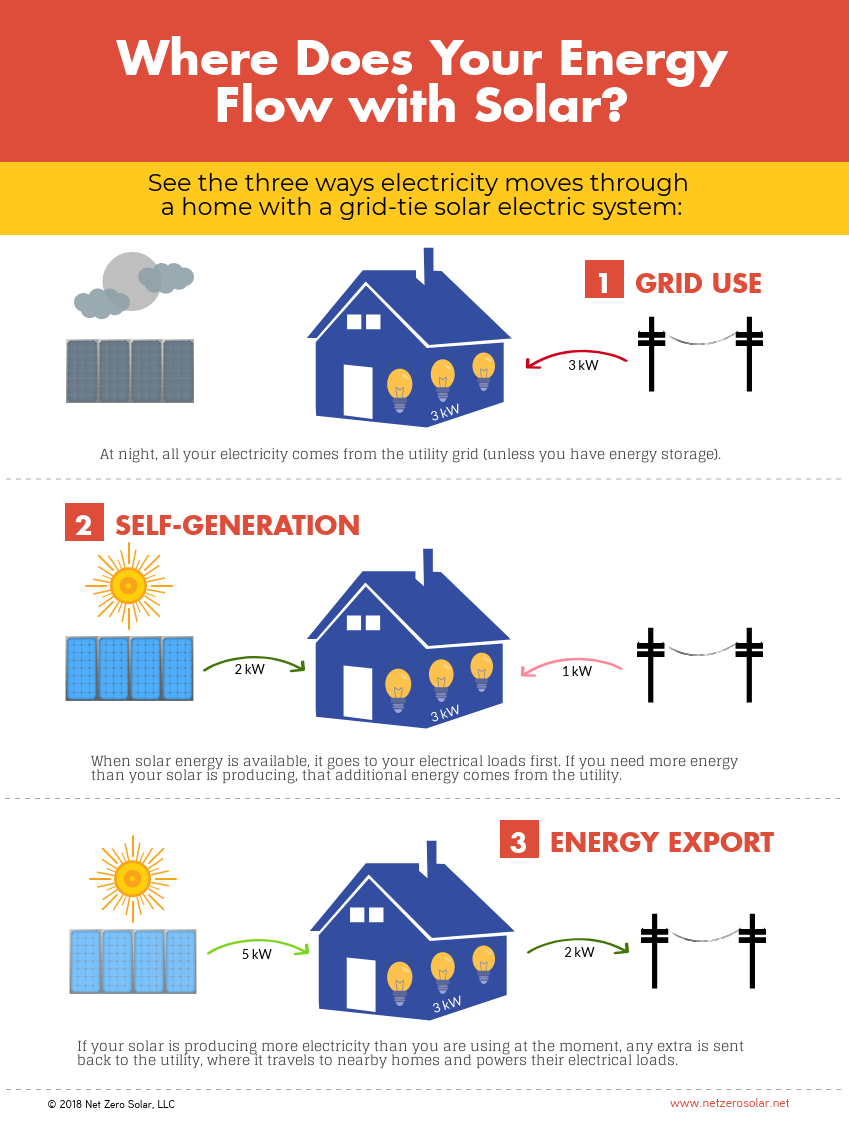
For most utilities, you will pay more for energy the utility sends to you (retail rate) than the utility will pay you for energy you send to them (export rate). This means that to maximize your savings from solar, you will want to use as much of solar energy as it is produced as possible.
At the end of your monthly billing period, the utility will calculate the cost of the energy you used from the grid, subtract a credit based on the energy you exported, and bill you for the remaining amount. For a detailed breakdown of how this works, see the infographic below.
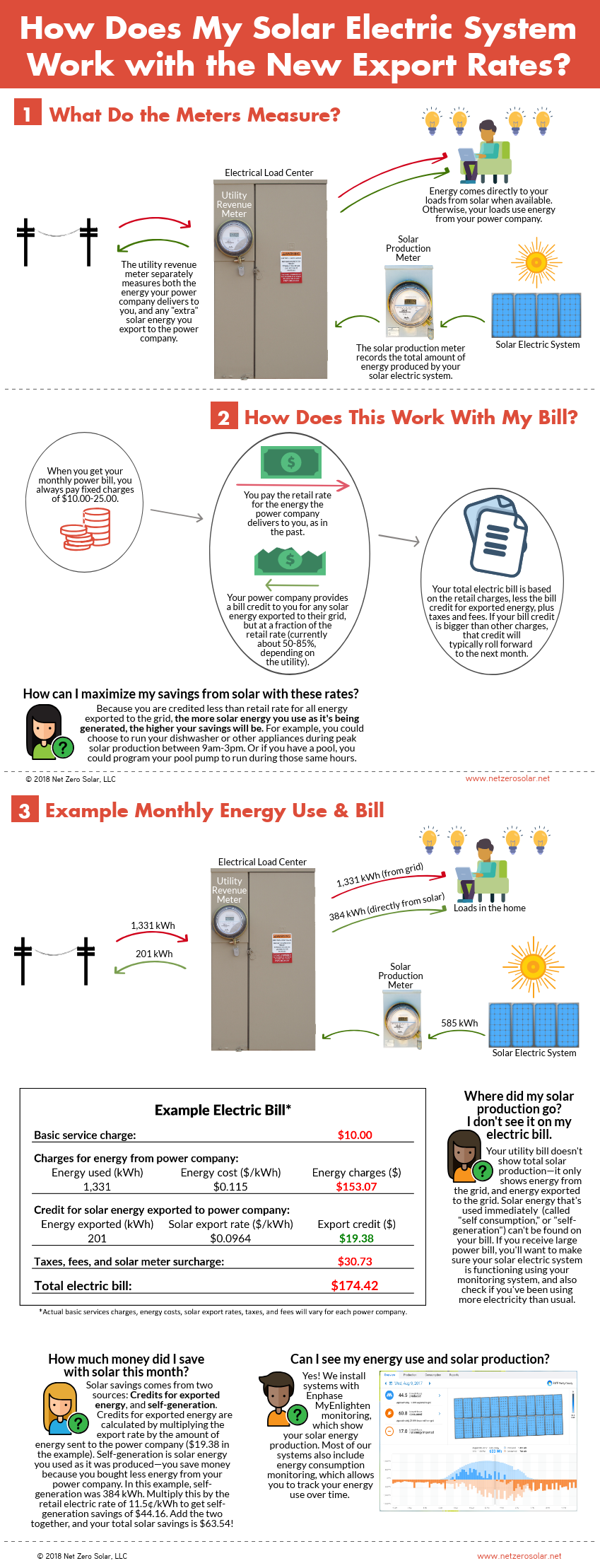
Because retail rates are different than export rates, your solar installer will have to figure out much energy you will self-generate and how much you’ll use from the grid to accurately estimate your savings. Ideally, you’ll need hourly energy data for your home or business from your utility or another source. We will compare your energy use and expected solar production for each hour of the year to determine your self-generation percentage, and model your electric bills with solar using this information.



945 W Silverlake Road Tucson, AZ 85713 520-207-4053
ROC# 248710, 259756